The fee model, and the moment it bills you
Four cost lines, one of which waits until submit. Knowing which one changes how you build the box.
Type what you want to find; results list product cards by category.
Four lines make the total
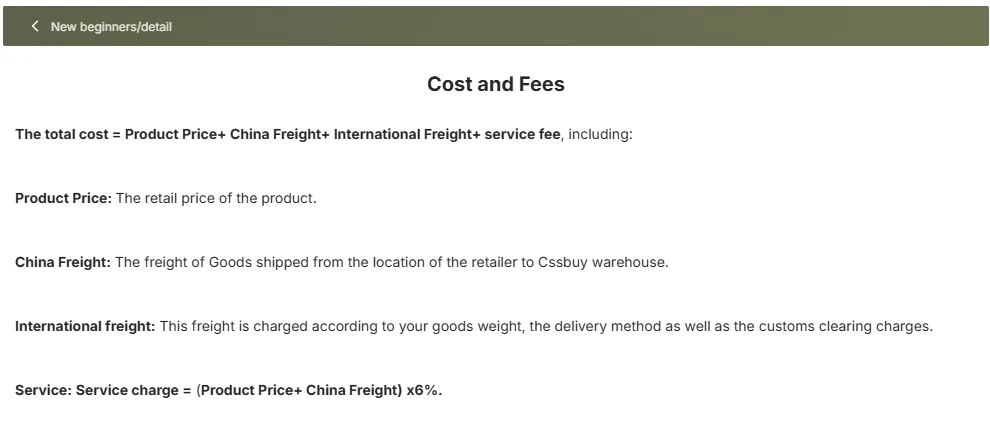
The operator's cost page is one sentence: total equals product price plus China freight plus international freight plus service fee, and the service charge is (product price + China freight) x 6 percent (help 12, read 2026-10-10).
The two freights are different animals: China freight is the seller-to-warehouse leg and gets combined when several orders from one seller are bought together (help 46); international freight is the box you build on the combine page.
A small calculation before the larger shipping bill
As a worked example only, take a product price of 200 CNY and China freight of 20 CNY. Applying the ordinary-account formula in the 10 October 2026 capture gives a 220 CNY service-fee base and a 13.20 CNY service charge. International freight is still a separate amount. These invented inputs explain the calculation; they are not an offer or a current route quote.
Now compare what your payment method actually charges to credit the required CNY balance. Record the debit in your currency, the credited amount and any separately stated fee. A percentage service charge and a payment conversion margin use different bases, so adding their headline percentages can misstate the cost.
Before confirming delivery, reconcile the wallet balance with the parcel’s freight, service charge and selected extras. A purchase payment that covered the goods does not by itself fund the shipping stage.
When the 6 percent actually lands
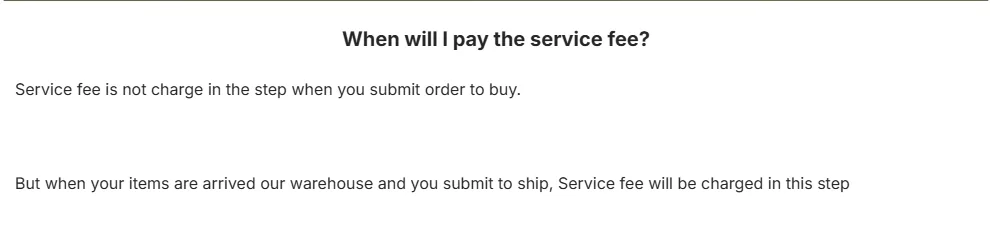
The service fee is not charged when you submit an order to buy; it is charged when the items are in the warehouse and you submit them to ship (help 115, read 2026-10-10).
For a haul that timing is friendly: you can cancel a seller's item at QC stage without having paid the fee on it, and the fee bills once, on the box you actually ship. It also means the submit screen, the same screen as the declared value, is where the real money concentrates.
The VIP ladder, in yuan
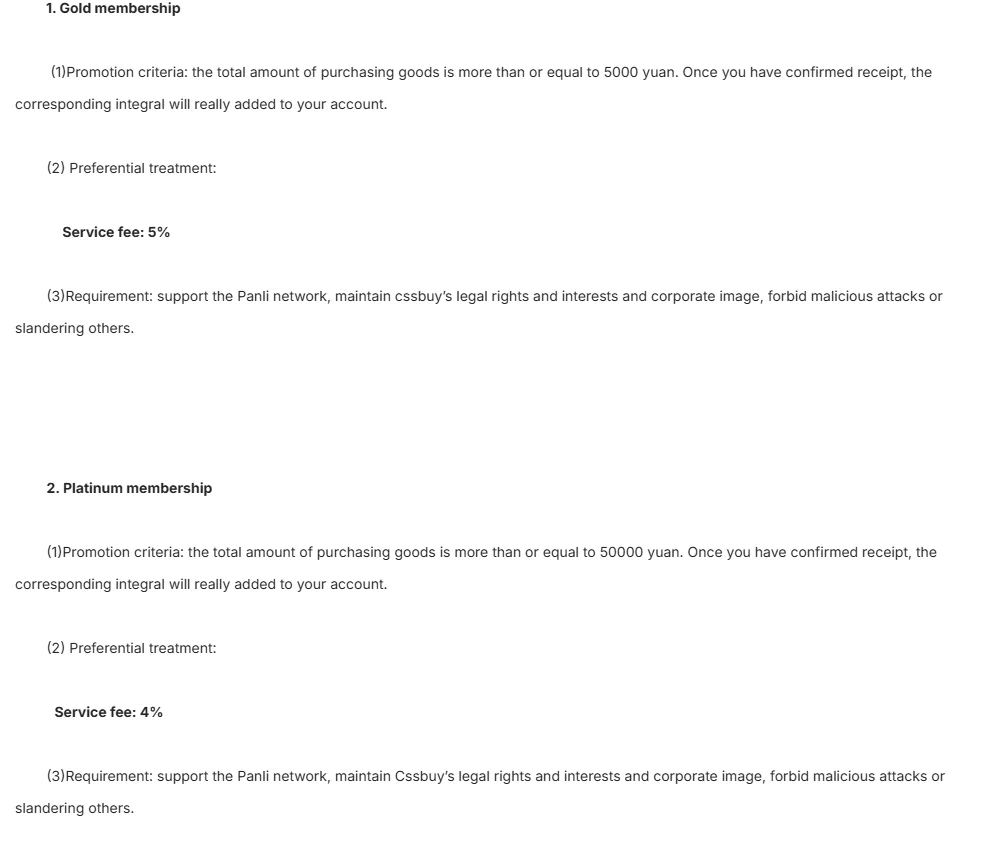
Cumulative purchases move the fee: Gold at 5,000 yuan lifetime spend pays 5 percent, Platinum at 50,000 pays 4, Diamond at 200,000 pays 3 (help 38, read 2026-10-10).
The ladder compounds quietly with the storage windows: a slow box built over weeks accrues spend before it accrues fees, so steady small hauls climb tiers faster than their size suggests.
Currencies, rails and one stale notice
The storefront quotes in USD with a currency switcher; the archived 2026-06-29 header listed USD, EUR, BRL, GBP, AUD, CAD, ARS and CNY. Checkout rails on the live pay-config, read 2026-10-10: PayPal in USD, several card rails, Alipay and WeChat Pay in CNY, dlocal and payssion for local methods.
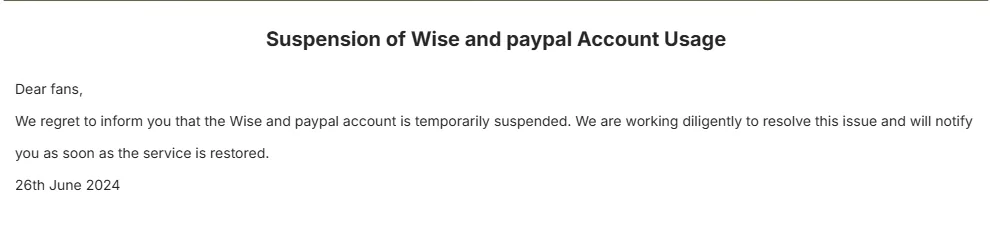
Two facts worth holding together: notice 150, dated 2024-06-26, suspending Wise and PayPal is still published, while the same day's live pay-config lists PayPal as enabled. When a rail matters to you, trust the checkout page on the day, not any archived notice, including this paragraph.
On conversion cost, an independent fee tracker's 2026-10-02 reading put the card rail's exchange margin at 0.4 percent. Dated single measurement, not a ranking.
Route cards price in USD, by weight step
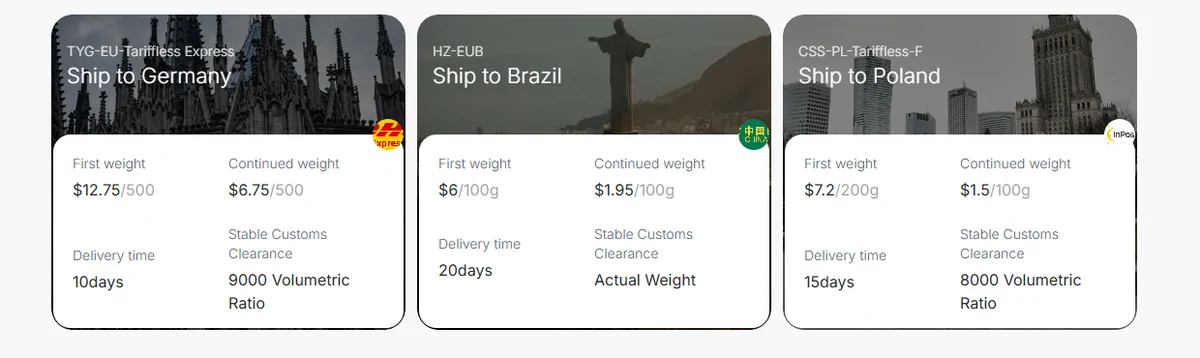
The homepage advertises three route cards, read 2026-10-10: a Germany Tariffless express at 12.75 USD first weight per 500 g, a Brazil line at 6 USD per first 100 g, and a Poland line at 7.2 USD per first 200 g, each with its own volumetric figure or actual-weight label printed on the card.
The cards are the operator's advertising snapshot, so treat the numbers as operator example values that move; the logged-in estimator prices your actual box. What the cards teach reliably is the shape of the pricing: a first-weight step, a continued step, and a per-line volumetric treatment, which is why no single divisor exists to quote.